Monday, March 31, 2014

Twitter is a useful tool, but it can be a sledge hammer as well.

I rarely debate on Twitter.  I interact with people and I trade friendly barbs with them but when someone comes forward with a Twitter "gotcha" (that really isn't) my default reaction is to find the quickest path possible to the block button.

Part of this is because I view Twitter as more of a news feed/informational tool than a tool for communication. It does a great job providing headlines and links to stories, cute pictures of animals and some very, very funny snark.  However, as a forum for debate Twitter is all but useless.

The problem, as I see it, is that 140 characters doesn't allow one much room for context. The idea of a subtle argument, rather than just blindly charging forward with insults and non-sequiturs, is lost when thoughts are condensed to a blurb.  Twitter is not about communication and more about information, much of it wrong.  How wrong?  There are many Twitter accounts claiming to tweet "facts" who post incorrect information over 50% of the time. In the world of the Internet, Twitter's factual accuracy ranks right up there with Wikipedia.

Then you have the anonymous nature of the platform. I've learned that people say crazy things when they believe they're shielded behind a shroud of electrons.  A typical Twitter Argument might break down as follows:

Blogawful: 'I like the new BMW M6, looks nice and sounds awesome.'
STUD12Muffin: 'The Chevy Corvette is better, you suck asshole!'
Blogawful: 'I'm not a fan of the handling on the Corvette.'
STUD12Muffin: 'Clearly you're a ****. Tired of losing?'

 Clearly this was made up, but I've experienced much of the same on almost any issue, politics, religion, sports, betting, food you name it. Express an opinion and there's always some angry Twitter user out there ready to regale you with their broad knowledge of curse words, and slim knowledge of the English language. "You suck" is the pinnacle of witty banter on Twitter. Snark, which is a lazy-person's weak attempt at satire or actual sarcasm, makes the Twitter world go-around. Snark has given us Rachel Maddow and other faux-witty commentators and it has reduced Dennis Miller to a shadow of his former (bitingly funny) self.

Snark has always been more a tool of progressives and the Left than it has the right. In part, because snark is fairly simple, anyone can do it, and also because snark is very hard to rebut in an intelligent manner. A reply to snark begets more snark which eventually leads to name-calling or something to allow the snarky one to claim a 'victory' which they can then quantify as one more notch on their Twitter headboard allowing them to put something along the lines of "humiliating conservatives for fun" in their public profiles.

The thing is, they do no such thing. Using snark to try and win an argument is like using a chicken to travel to California.  Yes, you might eventually get there, but the chicken is going to play almost no role in the matter.  As a matter of fact, the chicken probably will make your trip harder.  The point of being snarky is to shut down, not foster, debate. People using snark are not confident in their facts, so they go on the attack. This is why snark is such a big tool for the AGW crowd, for Peak Oil theorists, New Urbanists and old media-trained Directors of Communication for local pols.

It also makes for some pretty depressing Twitter conversations.

All that said, snark does have it's place. It's very good when preaching to the choir, and it's good for short, throw-away commentary.  While it won't win you a debate, it can be useful in helping to get the message across. Rachel Maddow, while not especially informative, does a very good job on her show communicating with the true believers on the Left, just as Rush Limbaugh does a good job communicating with those on the Right. They both used assumed fallacies to make their point in a snarky manner.  The rubes suck it up, the world spins on with little accomplished.

I, for one, prefer satire and sarcasm to snark, but most of all I prefer not to engage with those whose mind has already been made up before the first word is said. If your default strategy is to belittle the credibility of your foil in lieu of making an argument?  You're probably using snark. A bigger problem is that most don't understand the difference between satire, sarcasm and snark. So, for instance, when I term the extreme green movement "econmentals" to highlight that their position is, at it's heart, anti-human, people will say I'm using snark.  A typical response might look like this:

"Yet you call the environmentalists "ecomentals" and that's OK *wink*"

This is the problem you find on Twitter all too often.  There's nowhere to go with that statement that won't devolve into a flame-fest without the first mention of the fact that, in order for the green left's ideas to truly work, Billions of people are going to have to die. When confronted with that fact the practitioner of snark is going to quickly pull back with some kind of 'I won' statement or accuse you, without a hint of irony, of wanting to kill the poor.

This is a typical Twitter debate, and it's why I will not engage in them.  As it states in the sub-title of this blog however: Your mileage may vary.


Friday, March 28, 2014

MA 370 reveals everything wrong with media today

We've convicted the pilot based on the speculation of a few "experts" who have been ran out on CNN with no specific technical knowledge of what caused the plane to (apparently) crash.

This has happened because the media, in their current rush to be first rather than necessarily right, has told us he has "political ties" to some jihadists currently sitting in a Malaysian prison.  It's gotten so bad that Shah's son felt the need to come out and defend his father despite there being no evidence to pick apart.

When looking at the situation the only "fact" evident is that there are very few "facts" to go on.  We can't even find the plane, much less determine how (or why) it turned, whether it turned or whether there was a mechanical failure that might have caused it to turn.  The "fact" is we just don't know.  Anything offered now is speculation.  Speculation, I should add, that's needed to fill a 24/7 news cycle on channels overseen by people who don't think the American people have a desire to take a look at thorny domestic issues such as government finances or the continuing tragicomedy that is the Affordable Care Act.

It's gotten so bad I'm waiting for some talking head to call this Malaysia-gate.

It's not as if the so-called "good-old-days" were any better.  The dirty little secret of the media is that they've ALWAYS been about making money and turning some type of profit.  They act as if this isn't the case and that they were, once upon a time, loss leaders but the truth is that, in order to stay a going concern, you have to make money.

From Revolutionary times where newspaper founders were often businessmen whose editorial lean just happened to dovetail with their private interests, to the modern age where sales pitches masquerade as 'news', the media has always been nothing more than a private enterprise with the annoying belief that they have a right to pry into the lives of private citizens.

When someone is injured or dies tragically, here comes the media with their cameras, recorders and microphones shoving them in the faces of grieving families because "the public has a right to know" just how bad the loved-ones of the deceased are feeling right now. I believe the vernacular is "human interest stores". Bull. Crying children and spouses are ratings getters, page hit drivers, it's why the Las Vegas Review Journal recently had a "buy me" click-link on a picture of a recently deceased former casino owner. It's why every third story on ChronBlog, and almost every story on the Houston Press, contains some type of barely-relevant-to-the-story slide show.  A reporter died, so click on this slideshow of other reporters who have left Houston?

I have no idea whether or not Shah is guilty of turning the plane and crashing it as some have speculated. I also, at this time, have no idea what caused Malaysian 370 to crash, not crash, or even where the plane might be.  The thing is, neither do any of the people coming on CNN and other networks telling you what they think happened.

It's all just guesswork, much like every editorial ever written by Mrs. White.  The only advice I can give is to just turn it off, click elsewhere or use the dead-tree edition to start your BBQ coals.  Given most of the content, that's about all it's good for anyway.  Save your energy and time for the things that matter. Ignore peddlers of the journalism equivalent of snake oil, which doesn't matter in the slightest.

Wednesday, March 26, 2014

Sometimes vacations don't go as planned. (Las Vegas edition)

It all started with a notification from United airlines that the Dreamliner portion of our recent trip to Vegas (IAH to SFO) was delayed by 1 hour and 26 minutes.  Given that our entire layover in San Francisco was only 1 hour and 20 minutes I knew we had a problem.

This was around 4:30 in the morning.  Our flight was scheduled to depart at 7:00 AM on Thursday, the wife and I had booked a room on Wyndham points at a hotel next to the airport so we wouldn't have to drive in.  Even in my bleary-eyed state I knew we were looking at some booking gymnastics to eventually arrive at Las Vegas sometime that day.

I should have known there would be problems, after all, we were trying to get a flight on the Dreamliner, an airplane that's got a notoriously sketchy performance record as Boeing and it's partner airlines continue to work out the bugs.  Fortunately, that early in the morning, the call to United's MileagePlus service center only required about a 5 minute "hold time" before I was directly connected to an agent.  After explaining the situation the agent agreed that, yes, we were going to have to do some creative re-routing to make things work.

After about 20 minutes of searching and looking (including exploring the option of a US Airways first class indirect flight through Phoenix that departed at 5:55 AM) we decided that the best option was for us to throw away our BusinessFirst agenda heading to Las in Vegas and settle for a direct flight with United in Economy Plus.  The difference in miles was re-deposited into our account, and we eventually made it to LAS about 2 hours behind schedule.

While we weren't able to get a flight leg on the Dream(Nightmare)Liner, we did get to finally experience United's A320 economy experience with the new SlimLine seats. My overall impression of those is not good.  Not only are the seats very hard, but the armrests are not near long enough and it's almost impossible to get in a comfortable sitting position for a 3 hour flight.  Rumor is those seats will get better with time as they 'break in'.  We'll see. Right now I'd advise avoiding them if possible in favor of 739 or -8 service if available.

The A320 we were on had Wi-Fi available, but I didn't purchase it because I've heard the signal is dodgy.  This rumor was confirmed on both legs as people who did buy the system constantly had it dropped on them, forcing the purser to have to reset the signal, causing long delays in availability.

When we arrived in Las Vegas we had a quick cab ride to Treasure Island, where we were immediately placed in our room despite arriving before check-in time.  TI is a nice hotel, but very busy and they do charge a $28/day "resort fee" if you want to use any amenities whatsoever so be sure to include that in the price of your room.

Even worse, on this trip, I got hit with either a stomach bug or food poisoning on Saturday, which meant that I spent most of the weekend in my room either lying in bed or visiting our bathroom.  On a positive note: this kept me out of the sports books which is a good thing considering the state of my NCAA bracket.  That stomach ailment probably saved me a few hundred dollars in bets I would have made on losing teams.

Back among the living on Monday evening, we did get to see Mystere, which is an older Cirque du Solei show that has a couple of weak acts but some incredibly strong ones as well.  The strength and balance men in the show are amazing as is the trapeze act. It's a show I highly recommend. Obviously our food during this trip was a wash-out. On Monday I was eating bland so I don't think it's fair to say much about where we decided to dine.

On our return flight everything went as planned.  We were on another A320 flying out of Las Vegas, seated in BusinessFirst.  This was the first United flight where the purser identified us and called us by name when taking our lunch order.  Service in the 16-seat cabin was efficient.  The food was a choice between a cheeseburger and grilled chicken salad. neither are real solid menu options but both are edible. I will say this however, for some reason United has difficulty serving bread that is not stale.  Overall though it was a fine flight with good service and a staff that genuinely seemed engaged. That is not always the case with United these days.

Sickness aside, it was an OK trip and I was very impressed with United's customer service throughout in what was a difficult out-bound trip. I will go so-far as to say one of the best arguments for retaining status with United, considering all of the recent changes to MileagePlus, is continued access to the Premier customer service line.

I'd still like to fly on the new Dreamliner, but I've a feeling I will not for a while due to how unreliable of a plane it is right now. 


And next time: no cream in my morning coffee.

Wednesday, March 19, 2014

Ah yes the good old days, too bad you couldn't afford it (and neither could the airlines)

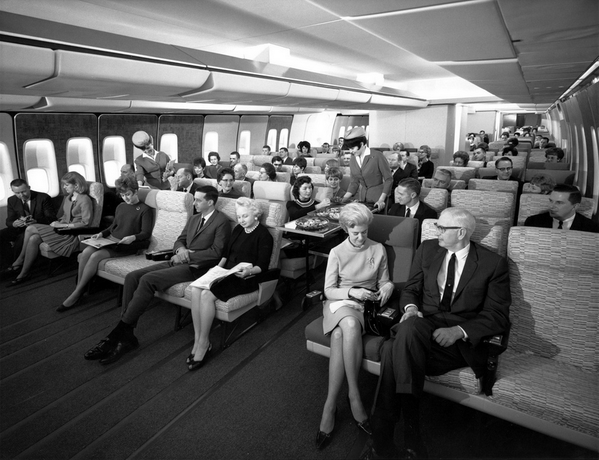
The "History in Pics" Twitter account posted the following1960's era, economy class promotional picture from Pan American Airlines....


Tweet here: https://twitter.com/HistoryInPics/status/446275400101273600/photo/1

It's a beautiful picture of people lounging with much legroom, a food cart coming by offering service to beautiful, happy group in a plane that appears to be about 3/4 full.

Before you go on to remark how big the seats are now and how much "better" things were back then keep in mind a few key facts:

1. There was no In-Fight Entertainment.
2. There was no Wi-Fi.

And finally....

3. Pan American filed for bankruptcy and is no longer a going concern.


For as much grief as the media (and people who rarely fly) give the airlines you'd think modern day economy is the worst thing in the world.  In fact, I would argue that it's much, much better these days. Fares are historically cheaper, there are more seats which means better availability and the airlines are turning a profit.

Are there things the airlines could do better?  Of course. I'd like to see improvements in timeliness and customer service, but the arguments against modern day economy class border on the ridiculous.

Also, keep in mind this: Unless you were upper, upper middle-class during that time you could not afford to fly. Now (almost) everyone can at least to some extent.


Friday, March 14, 2014

Are we witnessing "Last Vegas"? No.

Discouraging news for Caesars Entertainment.

Caesar's Entertainment reports $1.756 Billion quarterly loss on Atlantic City weakness. Howard Stutz, Las Vegas Review-Journal
Caesars Entertainment Corp. said Tuesday it lost $1.756 billion in the fourth quarter because of a deteriorating market in Atlantic City, which resulted in nearly $2 billion of noncash impairment charges to the casino company’s balance sheet.
Las Vegas-based Caesars said in a statement the company’s net revenue for the period ended Dec. 31 rose 3.2 percent to $2.078 billion,.
A year ago, Caesars’ said its net loss was $435.8 million. 

Ouch.

This continues a long string of losses for the big casino operators.  To that I can only say "good".

It's no secret that the wife and I love our visits to Las Vegas. I like the atmosphere, the people watching, playing poker and sports betting. I will even dabble a little in penny slots for pure entertainment, fully expecting to have fun losing $10 or so.  All that said you have to possess a pretty poor understanding of economics to not see that casinos and other gambling are a net drain on the economy. They add nothing of significant value and are more insidious than other forms of entertainment because they survive on a lie.

If you believe that you have a significant chance of wining a jackpot at a slot machine, consistently beating the casinos at poker or striking it rich at the craps or roulette table stop gambling now. In many ways those forms of gambling are worse than the lottery (which I consider to be a tax on those with poor math skills)  because the casinos pay out slightly better and advertise winners heavily. This is not to suggest that gambling should be illegal. Quite the contrary, I believe it should be very legal, and not just in Las Vegas.

It all comes down to personal responsibility, a concept that Americans (and the rest of the world really) seem to have given up on.  I like gambling because it's a form of entertainment. I also do not have an addictive personality and have no problem setting a budget and sticking to it. I also understand there are those who do get addicted to gambling and I think the casinos are being forced to do a better job at identifying them and locking them out. The thing is, if you are easily addicted then closing the casinos is not going to stop your gambling, it's just going to move it underground.

I don't think we'll see the end of Las Vegas as a tourist/convention destination just because some casinos are struggling. I do think we might be witnessing the beginning of the end of the big corporations who own multiple casinos with huge expansion and debt loads. If Caesars ever is in danger of going under there will be plenty of suitors for some of its larger properties. The future owners will probably be from Asia and will own fewer properties.  This could be a good thing in that it will bring real competition back to the city, which will improve room rates and possibly result in some of the sagging properties being forced to upgrade their amenities and rooms.

Until then, I'll continue to be their worst kind of customer. I buy cheap rooms, don't gamble much and spend a lot of my time nursing a drink and people watching. However, I do like to spend money on food and shows so they're still getting at my wallet to some degree.

The house always wins. No matter whether or not you gamble there.

Thursday, March 13, 2014

Kayaking Houston's Bayous: Good idea, shoddy reasoning.

Today the New Mrs. White waxed poetic about the increasing trend of kayaking Houston's bayou system.

Our Bayous. Mrs. White, ChronBlog
 The time is right to start making full recreational use of our bayou system on a regular basis, not just once a year. The Bayou Greens Initiative connecting 150 miles of trails and new Buffalo Bayou Park along Allen Parkway are great steps in that direction. In addition, the long-awaited site referred to as the Sunset Coffee Shop Building at 1019 Commerce at Main will offer kayak and canoe rentals by the end of the year. Another rental facility for boats will be located on the banks of the soon to be constructed "Lost Lake," which is at Dunlavy and Allen Parkway east of the Beth Yeshurun Cemetery. The put-in point for canoes and kayaks at Woodway near the 610 loop is set to be finished in early summer.
I think it's a great thing that Houston (along with the county and several other private and quasi-governmental entities) has taken strides to improve the water quality and recreational potential for Buffalo Bayou.  Truly this is a positive sign for the residents of Houston who might enjoy paddling down a lazy bayou on a sunny Summer's day.

As is usual, Mrs. White's problem is trying to make this something it's not.  This gem was buried at the bottom of the editorial:

Lake Austin/Buffalo Bayou. Not exactly apples to apples, but we predict that the sight of canoes and kayaks on the bayou will become inceasingly [sic] more common. People enjoybing[sic] themselves on our waterways will be an economic boost for the area and good for tourism. Skeptics may believe there is a field-of-dreams quality about the bayou as a recreation center. But 180 years ago, a dream about the bayou became the city of Houston.

Ignoring the copy errors for a minute (which runs into another theme of how bad the copy editing is at ChronBlog) the idea that kayaking on Houston's bayou system provides a meaningful economic and tourism boost is wrong-headed.  As is the idea Houston is an "indoor city".

Let me explain.

If you want to see evidence of the outdoor nature of Houstonians one needs only to visit one of Harris County's many parks on a Saturday or Sunday afternoon.  As I've mentioned before, I live on the NorthWest side of Harris County in the general vicinity of Bear Creek Park.  On the weekends, the park is packed with families either cooking out of playing games of soccer (organized or not), flying kites, using the jogging trails or a host of many other activities.  The same can be said for Memorial Park, Hermann Park, Disco Green, any of the multiple dog parks and other recreational areas with activities ranging from fitness circuits to disc golf.

Speaking of golf, have you ever tried to get a tee-time at Memorial Park on a Saturday?

The fact is many of Houston's residents take advantage of the great outdoors, even in the Summer when you don't need a grill to cook meat.  The problem, as Mrs. White and others see it, is that Harris County residents are not spending their time outside inside the Loop.  Outside of Disco Green, which I thought was a mistake at the time it was built but admit to being wrong about, downtown is better known for a good tunnel system, a train with a propensity of running down cars, bicyclists and pedestrians, but not outdoor recreation. Again, this doesn't mean that bayou kayaking is a bad idea, only that the image cast by the ruling class and their courtiers of Houston being a collection of sun-averse, mall shopping mole-persons is inaccurate at best, an outright lie at worst.

Yes, people in Houston shop at malls. So do people in Austin, Portland, Seattle and other cities that are considered outdoor meccas.  But people in Houston also shop in Rice Village, Town Centre and a host of other outdoor areas where you can find them walking around outside.  Have you been up to The Woodlands recently?  What the Bayou Initiative is, at it's heart, is a good amenity for people who live inside the Loop, especially in the Heights and in the burgeoning Near Northeast side. It's a great thing for residents of those areas that people who live here might drive down to (since Metro seems incapable of transporting them) during a weekend.

Where Mrs. White falls short is trying to tie this to the great white whale of tourism and the enigma that is economic development.  Houston has always been, and continues to be, a city where business gets done. It is not a tourist mecca, it is never going to be a top convention destination, although it does host conventions.  Houston is a place where people want to live because there are jobs and a relatively low cost of living.  Adding things like kayaking bayous will help increase the quality of living, but not tourism. I also highly doubt that the ability to paddle down a slow-moving estuary will be the kicker that determines whether or not people relocate here.  Economic development is driven by jobs and industry.

What worries me most when I read such ramblings is the history of Houston's leadership to listen to the unproductive class and take their eye off the ball. This proclivity has led to a crumbling infrastructure and a focus on trinkets designed to generate names on plaques which some feel build legacies.  Bayous and downtown parks are nice, as are bike trails. Modernizing and repairing the infrastructure, sequencing traffic lights, pollution control at a street level (Have you seen all of the litter strewn around Houston?) will do far more to improve Houston's reputation than a series of travel ads promoting our bayous to tourists.

That said, Mrs. White has always preferred the shiny over the practical, it's too bad there's little chance of this changing because a region that's as nice as Houston deserves better.
 

Wednesday, March 12, 2014

Want tax money? Start a project in a Houston TIRZ.

Since Monday, there have been three stories stuck behind the Chron's pay wall discussing plans to redirect tax monies to private companies.

City may help with Savoy's rebirth. Nancy Sarnoff, Houston Chronicle

City eyes tax break for razing blight. Mike Morris, Houston Chronicle

Houston's Midway to help redevelopment of Upper Kirby's Levy Park. Erin Mulvaney, Houston Chronicle 
 
Two of the three "investments" are being organized by Tax Increment Reinvestment Zones or TIRZ.  If you've followed my blogging for any period of time you know that I feel TIRZ are a horrible idea for two reasons. One, they (by their nature) pick winning and losing neighborhoods for development, quite often the winners are the affluent areas. Because of this there is less tax money in the till for the overall basic needs of the city. Two, they are ran by unelected boards who are making decisions regarding the use of very large sums of taxpayer money. In essence these TIRZ run with almost no oversight. In Houston, they are not audited in any meaningful way that I've ever seen, although I do presume that the City Controller (Ronald Green and before him Annise Parker) would have auditing authority so the problem probably lies with who's been in the office more than with the set-up of the TIRZ themselves.

Kevin Whited of BlogHouston has deemed these dealings "The Houston Way" and the Way appears to be on the come. In Houston (and Harris County for that matter) our elected leaders don't like being told what to do by the common class, in some cases it offends them when the citizens try.  TIRZ are a good way around that. You set up a TIRZ, place a politically connected individual as Chair, and then let them make the decisions you don't want to make lest people who aren't reaping the benefits become offended.

What this really means is that people who most Houstonians have never heard of, have never cast a ballot for, are given control over huge chunks of taxpayer money that, by law, can only be used within the TIRZ for it's "betterment" not for the good of the community as a whole.

On the surface, this would not be a bad thing. Would that the TIRZ used the money for roads, sidewalks and things that develop infrastructure I would say good on ya' and let's move forward. Unfortunately, most of the things TIRZ spend money on are either trinkets, or give-aways to private business.  TIRZ board members like art and parks and shiny things to which they can affix a plaque with their names on it in perpetuity, not streets and esplanades. And while it's true the TIRZ in the story is going to do sidewalk work, it's really just around the old Savoy with the rest of the money going to the owner of the hotel in terms of tax breaks.  The story of the Upper Kirby park is even worse.

Not that it will blunt any criticism, but I like parks.  I live near(ish) to Bear Creek park in NW Harris County and think it's great.  But these types of parks are really green spaces contained within a builder's control (in this case, in between two buildings owned by the same owner) whose sole value will be felt not by the community in the area, but by the property owner who can now charge higher rents for what are already sure to be upscale apartments. Never mind that the Upper Kirby area is thriving and there's probably no incentive needed for someone to make a go of luxury apartment living, this is a TIRZ project and has been determined to be something in-line with the greater good.

But what is the greater good?

In Houston, it's increasingly becoming a gentrified idyllic Houtopia where the poor can't get access to good public transportation where large increases in rents (which harm the poor) are seen as a good thing and where winners and losers are picked through the natural selection process of Tax Increment Reinvestment Zones.  The problem with the Houston Way, Houtopia and all of these other visions of grandeur is what is happening to the rest of the city while these enclaves of utter happiness and joy continue to insulate themselves from the rest of the city.

In some places, the road system resembles what one might expect to find in a third world country. You could homogenize milk on some parts of Navigation and other streets on the North East side. Even Richmond Ave on the rather affluent West side of Houston feels like you're driving over a moon-scape in places. Elsewhere, the city is struggling to fund the staffing needs of the fire department (whether due to poor management or a political agenda I'll leave to you) and the pension mess is looming on the horizon having been kicked down the road for several administrations now.  Houston does have the new rain tax revenue rolling in, but noises are already being made that even more tax money is going to be needed for repairs to its outdated, crumbling system.

Given all of this should spending tax money on a park and hotel in affluent areas really be the chief area of concern?  Also, how motivated are people going to be to fix blighted buildings if the neighborhoods and roads leading up to them more closely resemble a shanty-town than thriving communities? Of all of the programs above, I have less problems with the plan to redevelop blighted buildings. For one, it's going to be voted up or down by elected officials, and two, it's something that can benefit the city as a whole, not just specific regions. However, I still think a better use of money would be to fix the streets and infrastructure around these buildings, which is something Houston should have been doing all along.